


Conducting data-driven oversight to improve efficiency and fairness in the organ transplant system
Health Resources and Services Administration
- Capacity building
- Health
Skill Set:
Learn More:

About HRSA
The Health Resources and Services Administration (HRSA) provides health care to people who are geographically isolated and economically or medically vulnerable. HRSA’s mission is to improve health outcomes through access to quality services, a skilled health workforce, and innovative, high-value programs.
HRSA is responsible for the oversight of the Organ Procurement and Transplantation Network (OPTN), the national network that links organ donation and transplantation professionals to increase transplants and donations and help people with organ failure live healthier lives. HRSA hosted two U.S. Digital Corps Fellows to support OPTN modernization through a range of projects focused on mitigating inefficiencies and increasing transparency and accountability.
The challenge
There are over 103,000 adults and children on the national organ transplant waiting list, and an average of about 15 people on the waiting list die each day while waiting for an organ. Beyond the human cost, there is also an economic cost—the federal government spends about $50 billion annually on end-stage kidney care for people waiting for a kidney.
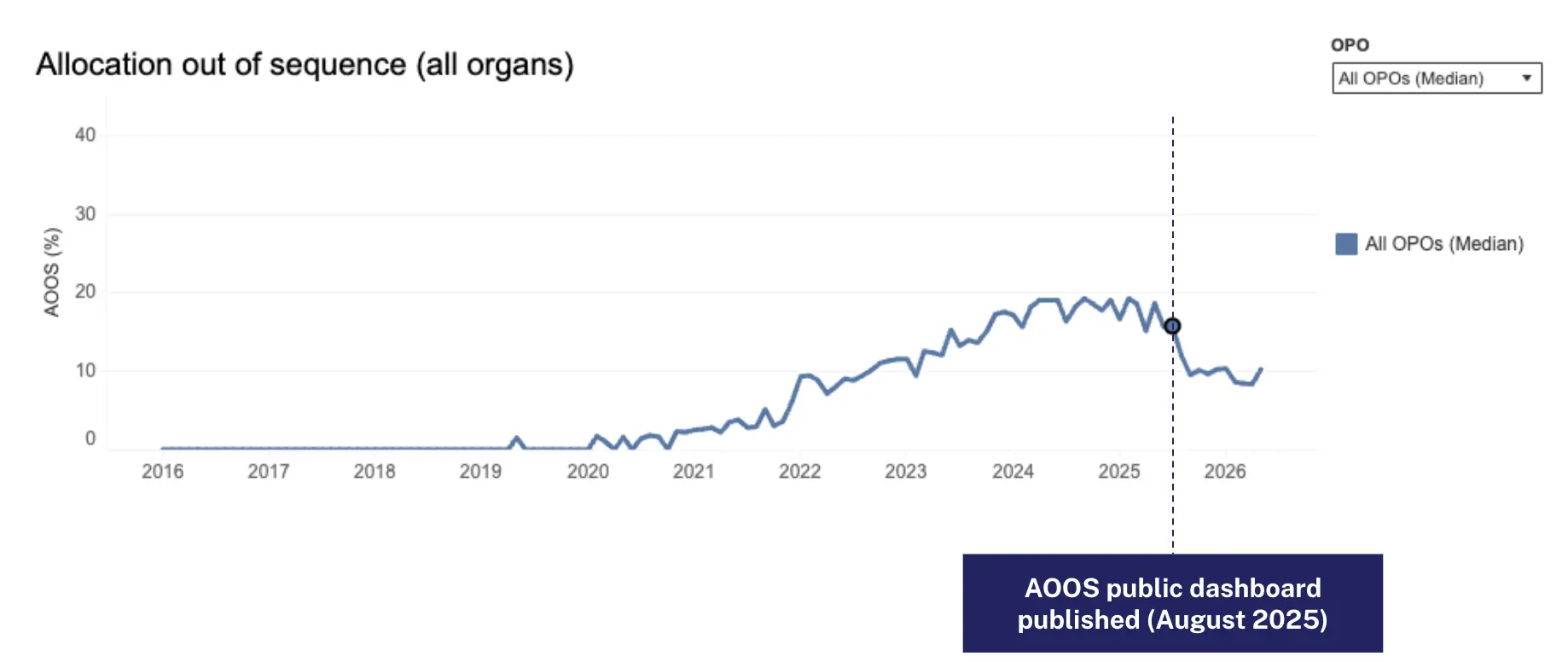
One challenge that rose to public prominence was a steady increase in allocation out of OPTN sequence (AOOS), an instance of policy noncompliance when an organ is allocated outside of the prioritized list of potential recipients for a donated organ. Instances of AOOS had been rising steadily—in 2024, over 9,000 organs (nearly 20%) were allocated out of sequence. While there are a range of reasons an organ procurement organization may engage in AOOS, AOOS actions are inconsistent with OPTN policy and cause skipped patients to potentially lose out on a life-saving transplant.
![A person holds a baby while a speech bubble next to them reads, When you call to try to talk to somebody, you never can get through. [...] I have to leave her six messages before she'll ever call me back.](/assets/images/projects/hrsa-aoos-example-graphic.webp)
The rising rates of AOOS were a matter of public scrutiny and triggered investigative journalism by mainstream news outlets as well as bipartisan congressional inquiries, which reflected a clear need for data-driven oversight to drive accountability and protect patient safety across the OPTN. However, organ procurement and transplant data is complex, vast, and often difficult to parse, making it challenging to discern patterns of waste, fraud, and abuse and communicate potential risks to policymakers, patients, and the public.
To strengthen patient safety, improve efficiency, and secure public trust, HRSA is undertaking a multi-year OPTN modernization initiative, which includes ongoing efforts to remediate AOOS. OPTN modernization also supports stronger oversight to combat potential waste, fraud, and abuse in the organ procurement and transplant system.
The approach
In 2024, HRSA established a Data & Analytics Team (DAT) within its Division of Transplantation with the goal of building out new data oversight capabilities. DAT is one critical effort to address a historic lack of resources, bandwidth, and technical expertise at HRSA to support the OPTN. DAT deploys data science, IT, and engineering expertise to leverage data to improve the nation’s organ procurement and transplant system.
The two USDC Fellows contributed to numerous DAT projects, including:
Bringing transparency to AOOS data: In 2024, HRSA received a critical comment describing documenting policy noncompliant AOOS activity within the OPTN. As part of HRSA’s response, a USDC Fellow leveraged her data analysis and product management skills to lead the development of a public dashboard quantifying AOOS rates across the country. Beyond AOOS rates, the dashboard also includes analysis of rates of organ non-use (when an organ is procured but not transplanted) and shows that rising AOOS rates did not lead to reduced organ non-use—sometimes used as a rationale for rising AOOS rates—and in fact correlated with an overall increase in non-use in recent years.
Transferring sensitive patient data in-house to HRSA: As part of the ongoing OPTN modernization effort, a USDC Fellow orchestrated a full transfer of sensitive patient safety data from contractor systems into internal HRSA databases. This provides HRSA full control of the data, minimizing HRSA’s reliance on contractors to access data it already owns and better enabling the agency to improve patient outcomes through effective oversight.
The impact
The USDC Fellows on DAT enabled HRSA to conduct stronger oversight activities that enabled the government to reduce waste, fraud, and abuse in the organ procurement and transplant system and improve outcomes for patients.
Since the public AOOS dashboard was published in August 2025, HRSA has observed a reduction in AOOS rates across the OPTN. Recent news articles revisiting the state of organ procurement have also directly pointed to the dashboard as a demonstration of HRSA improving transparency and public trust in the organ procurement system.
USDC Fellows are enabling HRSA’s shift towards building in-house technical expertise to support its oversight work for better patient outcomes—exemplified by their spearheading the AOOS dashboard release, HRSA’s first in-house data-driven oversight project. These efforts also supplement bipartisan congressional oversight over the OPTN.
With the public dashboard, organ procurement organizations in the OPTN are now able to see how their AOOS rates compare to those of their peers, strengthening their understanding of the field and how they might improve.
HRSA’s new control over OPTN patient safety data has enabled the first competitive OPTN contractor transition in over 40 years.
Two USDC Fellows graduated in July 2026 to full-time roles at HRSA, and HRSA continues to gather feedback from AOOS dashboard users, including doctors, researchers, and organ procurement organizations, to inform development of new features.
digitalcorps.gsa.gov
An official website of GSA’s Technology Transformation Services